You have spent eighteen months on your new 5G flagship. Your RF department has adjusted your antennas to surgical accuracy. In laboratory, conditions controlled, the connection is an illusion. Yet there comes the truth, which is, the Carrier Certification. The hand-off fails. Band switching gives the throughput a precipitous fall. The connection is “live” though the rate of data is half of what was promised.
Checking the logs again, there is no issue with hardware failure, no broken element. You find a timing ghost. The simple RFFE bus in the 5G New Radio (NR) world has become a dangerous chokepoint where a couple of microseconds can mean the difference between the successful launch and multi-million dollar delay.
The Hidden Complexity of Carrier Aggregation
The shift to 5G is not only about increasing the speed of the technology, but it is more of a huge increase in the number of bands your device has to handle at the same time. Your modem is always playing a game of Carrier Aggregation to combine various frequencies to achieve maximum throughput to meet demand.
Whenever your device changed its band or has changed its antenna, it is MIPI RFFE bus that gets to do the heavy lifting. It screams on Low Noise Amplifiers (LNAs), Power Amplifiers (PAs), switches, and antenna tuners.
Complexity vs Determinism
The Problem
- The larger the number of devices you connect to that common RFFE bus the greater you generate. In 5G NR, the spacing between subcarriers has become much less, so now your time to re-configure the RF front-end is limited dramatically.
The Penalty
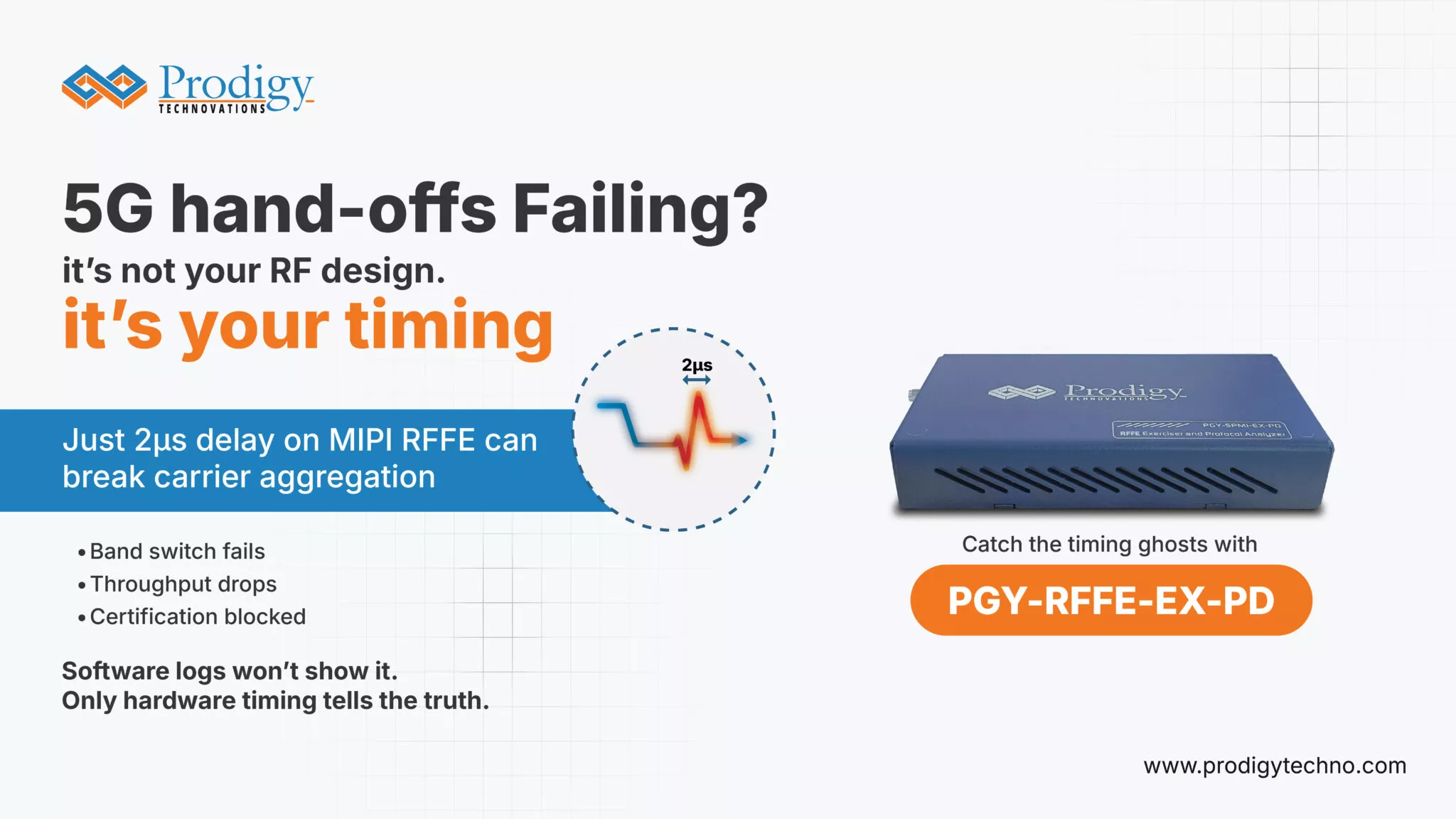
- Two microsecond late triggering Timed Trigger to an antenna tuner causes the modem to lose its phase lock. Your device simply disappeared in the blink of an eye to the carrier base station. The connection goes dead and your certification is left without hope.
The reason why Troubleshooting in a Textbook is a Trap
Software-level logs or simple protocol decoders are used a debugging technique done by most engineering teams when trying to debug these hand-off failures. This is a dangerous mistake.
A request-side truth that they tell you is software logs that the processor requested in sending a command. They do not provide you with the truth of the bus-side, of the nanosecond when the SCLK to SDATA transition was complete or the delay by which Slave took to respond to the command.
Unless you are measuring the Trigger-to-Execution latency on the hardware level, you are not debugging, you are guessing. You do not see the 2.5ns jitters, or the microsecond slipovers that literally put the system into a crash.
Reservation Your Budget of time back
These “war stories” have been enacted in the industry at Prodigy Technovations. Your carrier certification should not be a dice throw in our opinion.
We have our PGY-RFFE-EX-PD, which is geared towards placing you in complete control of the RFFE environment even before you ever enter the certification lab:
Precision Stress-Testing
- You may insert timing delays into the bus in 2.5ns steps, you may take the role of the Master. You could deliberately cause your RFFE slaves to reach the limit of their capacity so that you can know where they start losing commands.
Back-to-Back Trigger Validation
- Timed triggers in RFFE v3.0 enable close simultaneous reconfiguration of a range of components. The exerciser is simulating the modem traffic that is on the high speed to demonstrate that your hardware can support these fast trigger strings.
Cross-Domain Correlation
- The software does not simply list the packets but will automatically correlate the protocol data with a raw timing view. In case of a microsecond slip in a band hand-off you can observe the red flag just at the position where the event occurred on the actual wire.
The Bottom Line
The fight against 5G is decided within the microseconds. Unless your RFFE bus is deterministic, then your 5G performance is a myth.Quit permitting timing ghosts to determine the achievement of your product. Make sure that the purpose of your RF design matches the accuracy that it warrants.