





In the mobile industry, “Day 1” performance is easy to promote. But true engineering skill shows in “Day 180” performance. When a flagship device feels “laggy” after six months of real use, it’s rarely the processor’s fault. Usually, it’s a trade-off problem in the storage layer, especially how the system handles Single Level Cell (SLC) cache flushing and its effect on the protocol stack.
Marketing Bursts vs. Architectural Sanity
To achieve the fast sequential write speeds that help sell devices, UFS 4.0 uses Write Booster logic to store data in a high-speed SLC buffer. The challenge comes when this buffer fills up. To keep performance steady for the next burst, the firmware has to move, or flush, that data to the higher-density TLC or QLC NAND.
This presents a critical choice for Architects that impacts the entire protocol layer:
- Background Flushing: To keep the cache free for the subsequent burst, the system initiates a flush right away. However, when 8K video is being recorded or when an app is launching quickly, these background actions compete with foreground user duties, resulting in abrupt latency spikes.
- Idle-Time Flushing: The system waits for the device to be inactive. But if the UniPro Power Mode logic isn’t perfectly calibrated, the device may fail to enter deep sleep states correctly during the flush. This causes a “zombie” power drain that ruins battery benchmarks.
Validating the “Silent Killers” of Performance
We believe the role of a protocol analyzer isn’t just to see packets, it’s to provide the technical evidence needed to validate these high-stakes trade-offs. When a device fills to 70% capacity, fragmentation and cache management issues become the “silent killers” of user experience.
To ship a device that feels as fast at six months as it did on day one, validation teams must move beyond “max speed” and observe real-world behavior:
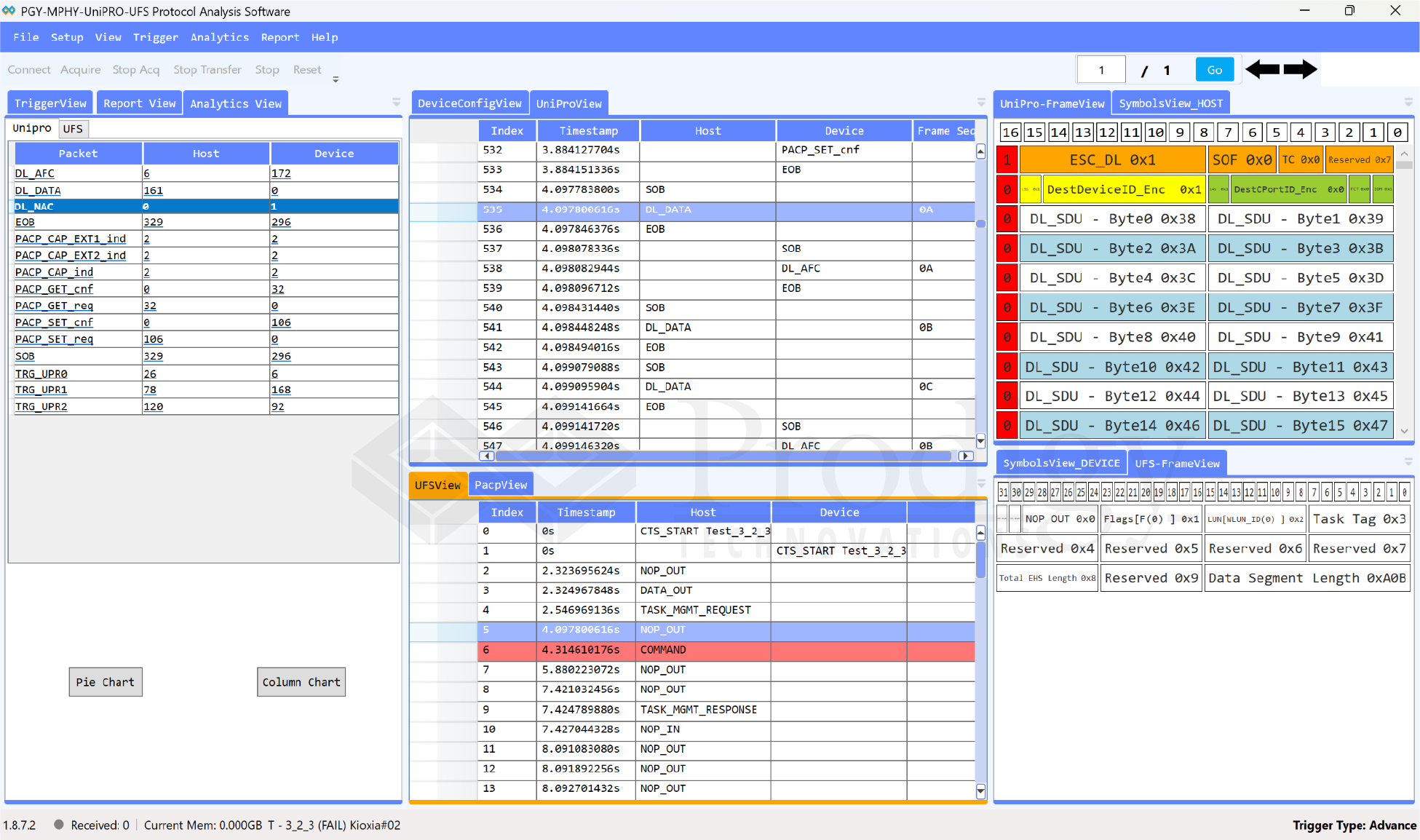
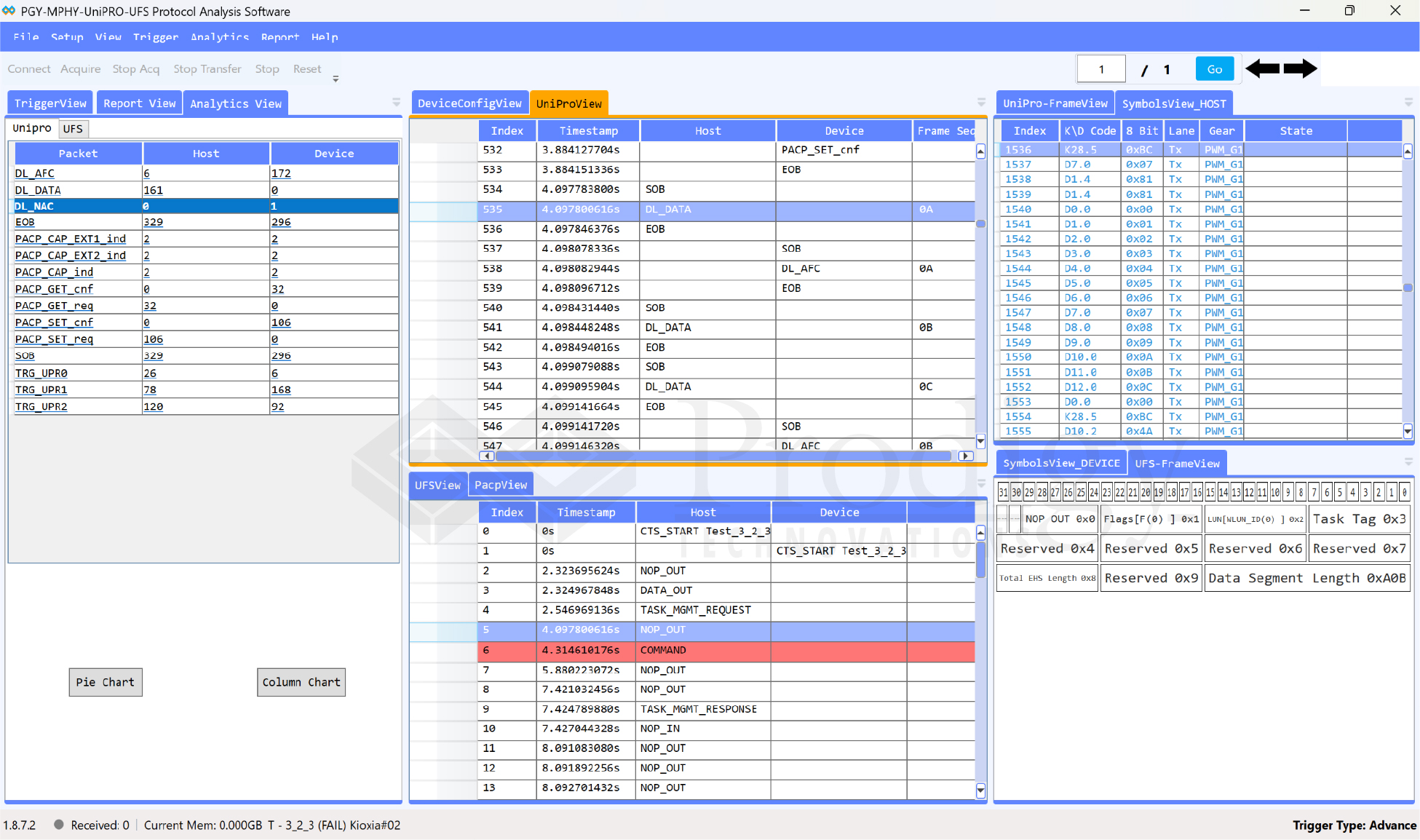
- Layer Correlation: The PGY-UFS 4.0-PA provides instantaneous decoding and correlation across MPHY, UniPro, and UFS layers. This allows engineers to see exactly how a UFS-level Write Booster command triggers MPHY state changes (like Stall or Prepare) in a single, time-stamped view.
- Long-Duration Stress Testing: Since cache issues are often time-dependent, the analyzer supports continuous streaming of protocol data directly to the host SSD. This enables teams to capture and analyze gigabytes of traffic over extended periods to catch the elusive 1% of latency spikes that occur during heavy flushing cycles.
- Power State Transparency: The software features a dedicated PACP (PHY Adapter Layer Control Protocol) view, making it easy to analyze power mode change packets and ensure the link is transitioning between high-speed and low-power gears without “hanging”.
Good engineering is about making fewer wrong decisions. By utilizing a Floating Window architecture, architects can view UFS, UniPro, and MPHY views on separate monitors simultaneously. This visibility ensures that when a packet is selected in the UFS layer, it is automatically correlated down to the MPHY layer, revealing the hidden cost of every flushing decision.
Don’t let a hidden buffer flush kill your brand’s reputation. Use high-fidelity protocol evidence to ensure your “Day 180” performance matches the “Day 1” hype.


