
The change to the more modern Universal Flash Storage (UFS) 4.1 marks a turning point in the data architecture of mobile and automotive systems. The protocol can deliver on-device generative AI and advanced ADAS sensor fusion with rates of up to 23.2 Gbps per lane, or High-Speed Gear 5 (HS-G5) Rate B. This speed increase, however, poses a major “Signal Integrity Wall” for the validation engineer because the way it is observed can completely change the behaviour of the system under test.
The Physics of 23.2 Gbps and the Probing Crisis
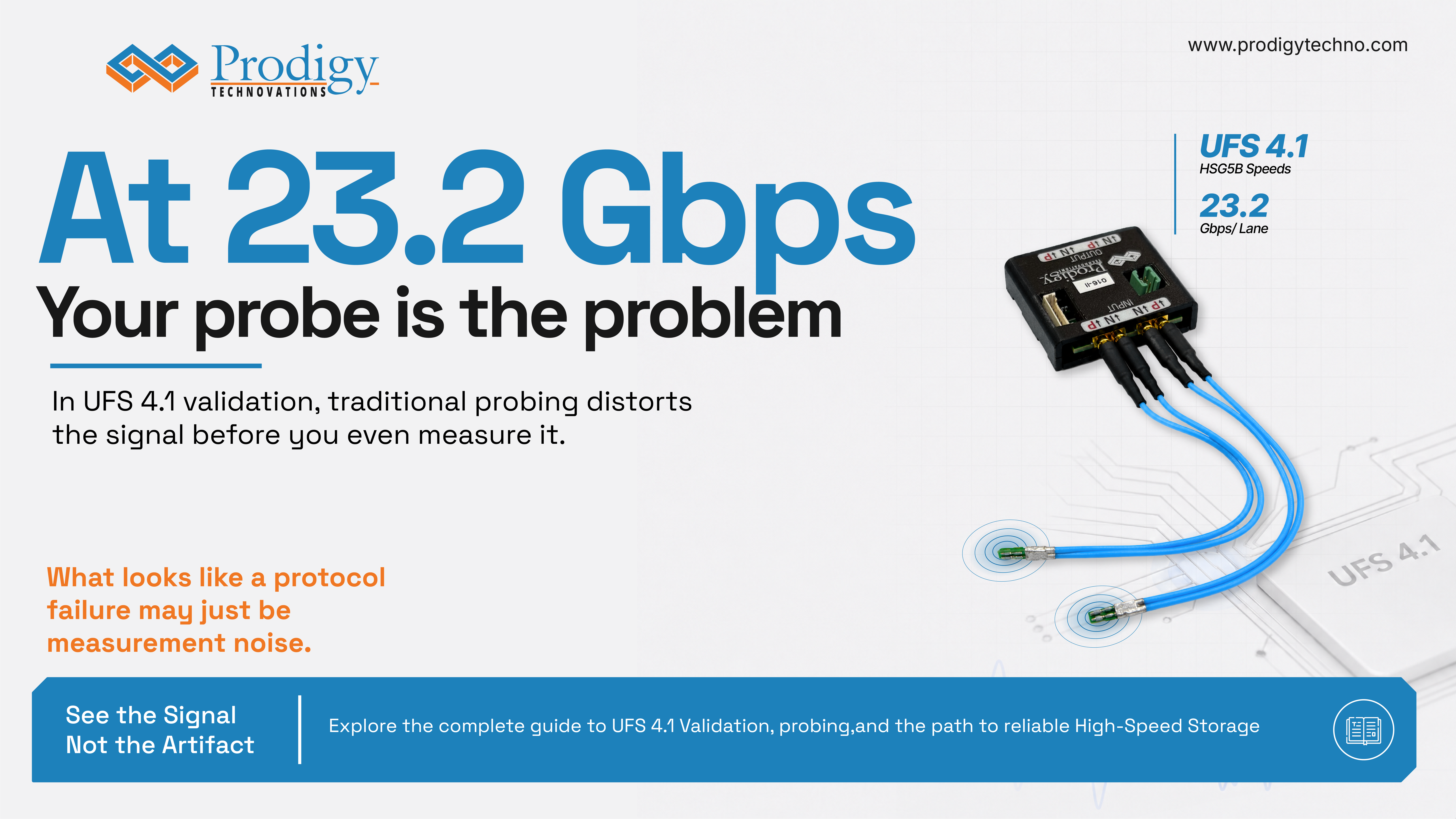
Traditional passive interposers can be a low pass filter at the frequencies needed for HS-G5B, which can lead to the distortion of the M-PHY signal before it reaches the analyzer. The tolerance for these high-speed serial links becomes essentially zero; in fact, a few tens of picofarads of parasitic loading from a probe tip can “stub” the transmission line, generating false Cyclic Redundancy Check (CRC) errors and protocol “ghosts” not in the silicon itself.
To achieve true “Ground Truth” visibility at UniPro HS‑G5 speeds, validation must move to Active Probing. At 23.2 Gbps, UniPro/M‑PHY signals require substantial analog headroom, and only high‑bandwidth active probes can provide this while preserving DUT performance. Prodigy’s UFS active probes minimize electrical loading and maintain signal integrity, enabling the analyzer to capture the real timing of UniPro state‑machine transitions, including the High‑Speed Link Startup Sequence (HS‑LSS). This level of visibility allows engineers to identify and correct initialization inefficiencies, often reducing overall link‑bring‑up time by more than half.
In this session, students will learn about advanced Probing Architectures: mSMP and B2B Interposers
Among the most important physical issues of today’s device validation is the PCB density. Often there are not enough room for the regular SMPM connectors around UFS test points. The solution to this is two major high fidelity architectures that emerged,
- Solder-down Active Probe Tips: These allow for direct access to M-PHY test pads between the host and the device. These tips provide high fidelity signal transmission with mSMP flexi-coax cables and are ideal for accessing the very close-packed mobile and automotive ECU boards.
- Board-to-Board (B2B) Interposers: If the UFS device is not soldered to the main PCB, B2B interposers with embedded probe tips are a better option for development platforms. These interposers decrease the trace length between the test point and the analyzer’s front end, which minimizes the attenuation and reflections of the signal.
Demonstrating how protocol and physical layers are correlated.Validation Alliance: Correlating Protocol and Physical Layers
Decoding of protocols is no longer on its own. When it comes to deep root cause analysis, the engineers need to correlate a protocol-level event (like a Write Booster SLC cache flush) with the physical-layer events that generated it (like an HPB map correlation error).
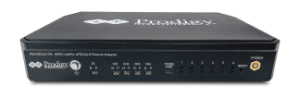
The PGY‑UFS 4.0‑PA incorporates a dedicated Trigger‑Out SMA interface that provides deterministic, hardware‑level correlation between protocol‑layer events and physical‑layer signal behavior. The trigger engine inside the analyzer continuously monitors UniPro and UFS traffic for user‑defined conditions such as protocol errors, state‑machine anomalies, timing violations, or specific command sequences. When the configured event occurs, the analyzer asserts a clean, fixed‑width 100‑ns TTL pulse on the Trigger‑Out port. This pulse can be routed directly to a high‑bandwidth oscilloscope, enabling the scope to capture the exact analog waveform present at the moment of the protocol‑layer event.
The move from Consumer UFS 2.2 to Automotive UFS 4.1 is covered in this Strategic Roadmap
This Strategic Roadmap covers the move from Consumer UFS 2.2 to Automotive UFS 4.1.
A platform that can tie the entire storage roadmap together is required for validation maturity. UFS 4.1 is the standard of choice, but the performance/price ratio of UFS 2.2 is still ideal for many consumer consumer systems and automotive systems use UFS 3.1 for the challenging thermal conditions of the vehicle space where data storage must continue to perform reliably under temperatures ranging from -40 oC to +105 oC.
This 10-year evolutionary leap v2.1 – v4.1 needs to be covered by a modern validation tool on a single hardware unit. This means that “Backward Compatibility” doesn’t turn into “Behavioral Instability”, especially in transitioning between sleepy states (Hibernate) and “Zombie” power drains that can result from legacy firmware not exiting sleepy states during background flush cycles.
For flagship products, the ability to deliver peak theoretical performance won’t be the differentiator, it will be the ability to be “Day 180” reliable as we move forward with UFS 5.0 and beyond. With the probing paradigm and the use of high fidelity mSMP and B2B interposers, validation teams can break out of the synthetic benchmark. They can now see the truth of the protocol, making their designs communicate with purpose across all high-speed transitions.