
• English
  • Products

    Protocol Exercisers & Analyzers

    • Storage
    • PCIe Protocol Analyzer
    • UFS 4.0 Protocol Analyzer
    • UFS 3.0 Protocol Analyzer
    • SoC based UFS Tester
    • eMMC,SD,SDIO Protocol Analyzer
    • SD, eMMC AC/DC Tester
    • SoC based eMMC Tester
    • QSPI Protocol Exerciser & Analyzer
    • UHS II Protocol Exerciser & Analyzer
    • Mobile
    • I3C Protocol Exerciser & Analyzer
    • RFFE Protocol Exerciser & Analyzer
    • Automotive
    • xSPI Protocol Exerciser & Analyzer
    • 100Base-T1 Automotive Ethernet Protocol Analyzer

    Protocol Exercisers & Analyzers

    • Computer
    • PCIe Protocol Analyzer
    • PCIe Side Band Signal Analyzer
    • SRIO Protocol Analyzer
    • UART Protocol Exerciser & Analyzer
    • SPMI Protocol Exerciser & Analyzer
    • Others
    • I2C/SPI Protocol Exerciser & Analyzer
    • PMBus Protocol Exerciser & Analyzer
    • JTAG Protocol Exerciser & Analyzer
    • SMBus Protocol Exerciser & Analyzer
    • MDIO Protocol Exerciser & Analyzer
    • 100G 802.3_2015 BERT & Analyzer

    Logic Analyzer

    • Discovery series for Embedded Interface

    Oscilloscope Based Software

    • Memory
    • UFS 3.0
    • QSPI
    • ONFI v4
    • eMMC 5.1/5.0/4.51
    • SD
    • Automotive
    • 10BaseT1S
    • 100Base T1
    • FlexRay
    • Others
    • I2C
    • SPI
    • UART
    • I2S
    • JTAG
    • SMBus

    Oscilloscope oftware

    • Computer
    • USB-PD
    • USB 2.0
    • USB 3.0
    • USB 3.1
    • STEPg1
    • PCIe
    • SPMI
    • HDMI
    • MHL
    • eSPI
    • Mobile
    • I3C EV
    • I3C PD
    • UniPRO
    • LLI
    • RFFE
    • HSIC
    • DigRF v4
    • SSIC
  • Resources

    Datasheets

    Application Notes

    Videos

    • Protocol Analyzer
    • Logic Analyzer

    blogs

    Forum

    Prodigy Partner Central

    • Login
  • Company

    Overview

    • About Us
    • Leadership Team

    Distributors

    • I2C
    • I3C
    • Other Protocols

    News

    • News
    • Automotive

    events

    • Webinar

    Newsletters

    • Automotive
  • Career
  • Support
What can we help you find?
  • Products

    Protocol Exercisers & Analyzers

    • Storage
    • PCIe Protocol Analyzer
    • UFS 4.0 Protocol Analyzer
    • UFS 3.0 Protocol Analyzer
    • SoC based UFS Tester
    • eMMC,SD,SDIO Protocol Analyzer
    • SD, eMMC AC/DC Tester
    • SoC based eMMC Tester
    • QSPI Protocol Exerciser & Analyzer
    • UHS II Protocol Exerciser & Analyzer
    • Mobile
    • I3C Protocol Exerciser & Analyzer
    • RFFE Protocol Exerciser & Analyzer
    • Automotive
    • xSPI Protocol Exerciser & Analyzer
    • 100Base-T1 Automotive Ethernet Protocol Analyzer

    Protocol Exercisers & Analyzers

    • Computer
    • PCIe Protocol Analyzer
    • PCIe Side Band Signal Analyzer
    • SRIO Protocol Analyzer
    • UART Protocol Exerciser & Analyzer
    • SPMI Protocol Exerciser & Analyzer
    • Others
    • I2C/SPI Protocol Exerciser & Analyzer
    • PMBus Protocol Exerciser & Analyzer
    • JTAG Protocol Exerciser & Analyzer
    • SMBus Protocol Exerciser & Analyzer
    • MDIO Protocol Exerciser & Analyzer
    • 100G 802.3_2015 BERT & Analyzer

    Logic Analyzer

    • Discovery series for Embedded Interface

    Oscilloscope Based Software

    • Memory
    • UFS 3.0
    • QSPI
    • ONFI v4
    • eMMC 5.1/5.0/4.51
    • SD
    • Automotive
    • 10BaseT1S
    • 100Base T1
    • FlexRay
    • Others
    • I2C
    • SPI
    • UART
    • I2S
    • JTAG
    • SMBus

    Oscilloscope oftware

    • Computer
    • USB-PD
    • USB 2.0
    • USB 3.0
    • USB 3.1
    • STEPg1
    • PCIe
    • SPMI
    • HDMI
    • MHL
    • eSPI
    • Mobile
    • I3C EV
    • I3C PD
    • UniPRO
    • LLI
    • RFFE
    • HSIC
    • DigRF v4
    • SSIC
  • Resources

    Datasheets

    Application Notes

    Videos

    • Protocol Analyzer
    • Logic Analyzer

    blogs

    Forum

    Prodigy Partner Central

    • Login
  • Company

    Overview

    • About Us
    • Leadership Team

    Distributors

    • I2C
    • I3C
    • Other Protocols

    News

    • News
    • Automotive

    events

    • Webinar

    Newsletters

    • Automotive
  • Career
  • Support
  • English

Today, the accelerated (32 GT/s) PCIe Gen 5 speed and the vast throughput of AI clusters dominate the technical vernacular in the modern data center. But a revolution is going on “beyond the main bus. The communication layer that monitors the health of the hardware, manages power states and protects hardware security is moving from legacy I2C/SMBus architectures to the Improved Inter-Integrated Circuit (I3C) standard. It’s partly due to the demand for deterministic, secure and fast telemetry in Compute Express Link (CXL) and DDR5 systems.

This discussion considers the reasons why SMBus cannot keep pace with the Legacy Wall

  • The I2C-based System Management Bus (SMBus) has been adequate enough for such simple tasks for years, such as accessing a voltage level or a temperature sensor. As systems have grown into AI fueled hyperscale systems, though, its shortcomings have become significant system-level constraints.
  • The number of buses in the bus loading problem and the complexity of the load multiplexer.
  • I2C’s top speed is 1Mbps. With high density components such as DDR5 modules that combine the SPD Hubs, PMICs and dual temperature sensors, the capacitance associated with these buses can sometimes make for the use of physical multiplexers (MUXes). This architecture brings in communication problems and boosts the possibility of signal integrity failures.
  • The Polling Tax
  • Unlike other bus types, in SMBus there is no efficient interrupt mechanism so the Baseboard Management Controller (BMC) dons the role of constant polling all of the devices. This results in the delay of response time and power wastage.
  • Fixed Addressing
  • Address is hardware bound in Legacy I2C. This becomes difficult in the case of a lot of identical devices in massive server racks which must be remapped to prevent collisions, otherwise it is not possible to address the databases.

The I3C Logic Stack (MCTP, SPDM and PLDM)

I3C addresses these problems with 12.5 MHz clocks to meet tight timing requirements, In-Band Interrupts (IBI) for signaling nearly instantaneously and Dynamic Address Assignment (DAA) that prevents static mapping conflicts. What is most significant is that it offers the strong transport services needed for contemporary management protocols.

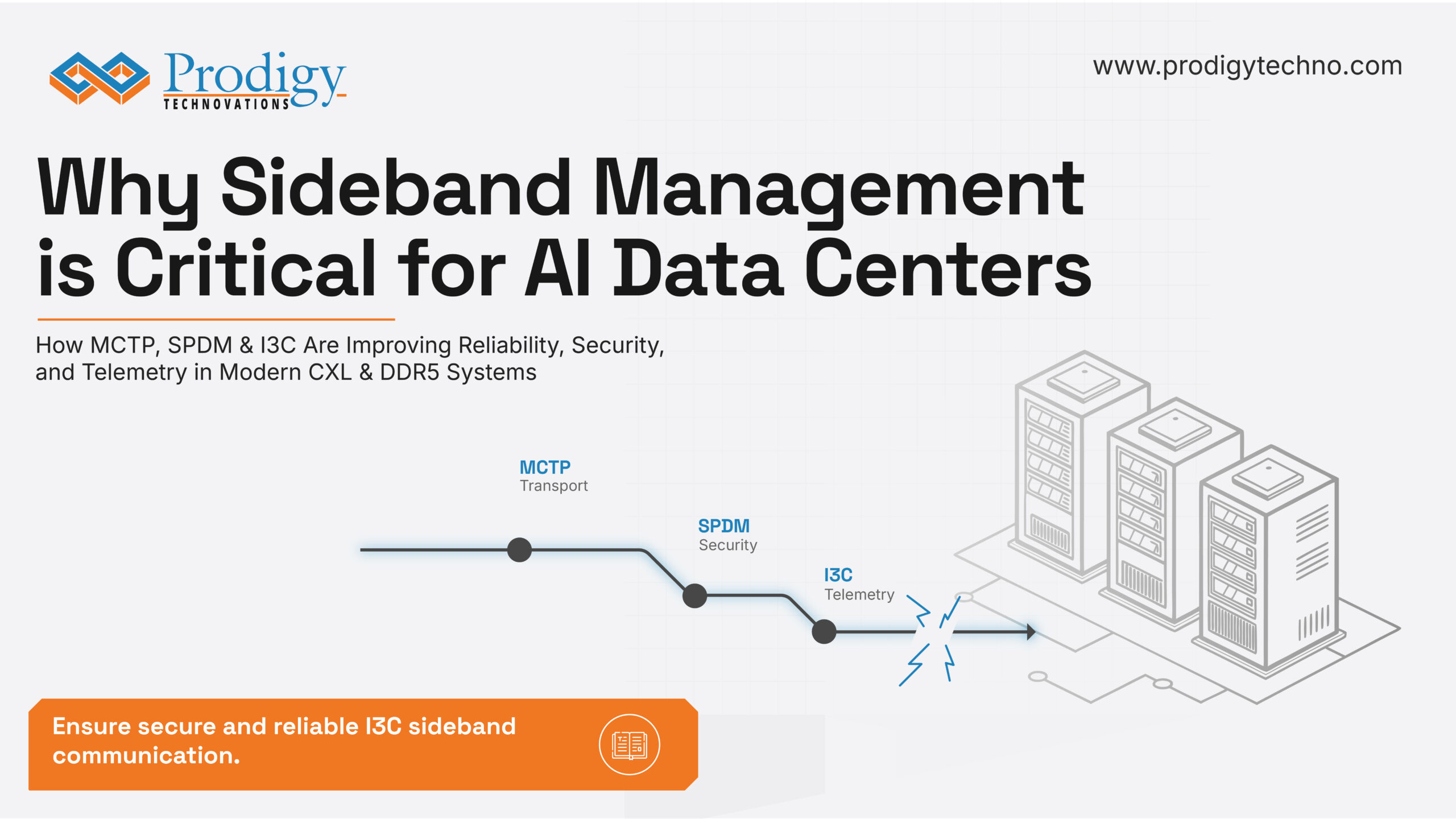
  • MCTP (Management Component Transport Protocol) – It provides the framing for data transport for intercommunication between management controllers, GPUs, and CPUs, and their shared I3C bus, in a standard manner.
  • SPDM (Security Protocol and Data Model) – SPDM provides for the discovery, authentication and recovery of cryptographic measurement data from devices. A single SPDM transaction can take up to 100ms to complete a critical timing window during which if a bus hang or MUX induced glitch occurs, a secure boot sequence can be compromised or even become stuck (bricked).
  • PLDM (Platform Level Data Model) – PLDM is responsible for managing platform monitoring, platform power state change and firmware update throughout the platform to keep the system in a known, healthy state.

The sideband challenges in CXL and memory pooling

The sideband health is no longer “optional”, but necessary in CXL architectures to ensure memory coherency. In the event of a failure of the sideband bus (I3C/MCTP) during a memory-pooling request or during the retrieval of the security, the coherency or even the stability of the entire high speed AI cluster can be lost. Likewise, I3C is used in DDR5 and QSFP modules to overcome the problem of hundreds of sensors waking up at the same time, creating an initialization bottleneck.

What does it mean to validate? What is validation?

Tools that enable the validation of this sideband frontier need to enable more than just bit-level decoding – they must provide visibility and emulation on the protocol layer and system layer.

  • PGY-I3C-EX-PD Protocol Exerciser and Analyzer – Engineers can simulate Controllers, Secondary Controllers and Targets on this platform. It allows injecting CRC or parity errors in SPDM query-responses to test security-layer timeouts recovery by firmware.
  • Low-Cost Tooling – Solutions such as EX-PD-Lite are designed for manufacturing and Post-Silicon Validation (PPV) environments, while the I3C-USB Adaptor offers a light-weight, offline UI for field engineers to debug sensors when on the move.
  • For deep root cause analysis, protocol data needs to be correlated with physical layer waveforms, which is not possible with the Validation Alliance. Prodigy’s integration with high end oscilloscopes from Keysight, Tektronix, and LeCroy enables the engineer to go directly from an MCTP-packet error to the noise spike that arrives at the same location 5ns later.

Reliability of data centric is taking more and more to rely as well on integrity of sideband. Xorcom’s validation of the intent of sideband protocols, rather than packets, will continue to be a key distinguishing factor in high-performance engineering as industries transition to UFS 4.1 for automotive storage and CXL for disaggregated memory. Knowing how to use the I3C logic stack, validation teams can make sure that their designs are as fast and responsive as the high-speed buses they’re managing.

  • Next Probing Paradigm Mastering Signal Fidelity in UFS 4.1 Validation using mSMP and B2B Interposers

Leave a Reply Cancel reply

You must be logged in to post a comment.

Recent Posts

  • Sideband Management (MCTP/SPDM) is the New Frontier of Data Center Reliability for good reasons.
  • Probing Paradigm Mastering Signal Fidelity in UFS 4.1 Validation using mSMP and B2B Interposers
  • Why Your On-Device AI Feature Fails at 3am When Nobody Is Looking
  • 5G Hand offs: RFFE Timing is Killing Your Carrier Certification
  • Why Gen 5 Speed is a Myth (Unless You fix the Protocol)

Recent Comments

No comments to show.

Archives

  • May 2026
  • April 2026
  • March 2026
  • February 2026
  • August 2025
  • July 2025
  • May 2025
  • April 2025
  • March 2025
  • October 2024
  • August 2024
  • July 2024
  • February 2024
  • December 2023
  • June 2023
  • May 2023
  • January 2021
  • November 2020
  • April 2020
  • September 2019

Categories

  • All products
  • Automotive
  • Datasheet
  • Device
  • Differences
  • eMMC
  • eMMC Protocol Analyzer
  • I2C
  • I3C
  • Logic Analyzer
  • Memory
  • news
  • PCIe
  • Protocols
  • SD
  • SDIO
  • SPI
  • UFS
  • Uncategorized
  • XSPI Protocol Analyzer
  • XSPI Protocol Analyzer

Search

Categories

  • All products
  • Automotive
  • Datasheet
  • Device
  • Differences
  • eMMC
  • eMMC Protocol Analyzer
  • I2C
  • I3C
  • Logic Analyzer
  • Memory
  • news
  • PCIe
  • Protocols
  • SD
  • SDIO
  • SPI
  • UFS
  • Uncategorized
  • XSPI Protocol Analyzer
  • XSPI Protocol Analyzer

Tags

100Base-T1 Automotive Ethernet Protocol Analyzer Clock Stretching DDR5 eMMC Protocol Analyzer I2C I3C I3C Protocol Logic Analyzer Passed PCIe PCIe Protocol Analyzer RFFE SD SDIO Serial RapidIO Protocol Analyzer UFS UFS 4.0 Webinar XSPI Protocol Analyzer

Our team represents a talented, experienced, and highly specialized group of development engineers, sales and marketing specialists. Through many years of direct engineering involvement with our customers, our personnel have developed expertise in wide range of technologies in serial data.

Follow us on

Linkedin Twitter Facebook Youtube

Quick links

  • Products
  • Resources
  • Company
  • Career
  • Support

Contact info

Prodigy Technovations Pvt Ltd

#294, 3rd Floor, 7th Cross, 7th Main, BTM II Stage,Bangalore – 560 076 | India

+91 80 4212 6100

contact@prodigytechno.com

© 2023 Prodigy Technovations. All Rights Reserved

Request Quote
Request Demo

https://www.youtube.com/watch?v=d9MHo4Ps78g

UFS 4.0


PGY-UFS4.0-PA, UFS Protocol Analyzer is the industry-first working and tested UFS4.0 Protocol Analyzer. It offers protocol data capture and debugging of data across MPHY, UniPro, and UFS protocol layers…


X
  • English