
• English
  • Products

    Protocol Exercisers & Analyzers

    • Storage
    • PCIe Protocol Analyzer
    • UFS 4.0 Protocol Analyzer
    • UFS 3.0 Protocol Analyzer
    • SoC based UFS Tester
    • eMMC,SD,SDIO Protocol Analyzer
    • SD, eMMC AC/DC Tester
    • SoC based eMMC Tester
    • QSPI Protocol Exerciser & Analyzer
    • UHS II Protocol Exerciser & Analyzer
    • Mobile
    • I3C Protocol Exerciser & Analyzer
    • RFFE Protocol Exerciser & Analyzer
    • Automotive
    • xSPI Protocol Exerciser & Analyzer
    • 100Base-T1 Automotive Ethernet Protocol Analyzer

    Protocol Exercisers & Analyzers

    • Computer
    • PCIe Protocol Analyzer
    • PCIe Side Band Signal Analyzer
    • SRIO Protocol Analyzer
    • UART Protocol Exerciser & Analyzer
    • SPMI Protocol Exerciser & Analyzer
    • Others
    • I2C/SPI Protocol Exerciser & Analyzer
    • PMBus Protocol Exerciser & Analyzer
    • JTAG Protocol Exerciser & Analyzer
    • SMBus Protocol Exerciser & Analyzer
    • MDIO Protocol Exerciser & Analyzer
    • 100G 802.3_2015 BERT & Analyzer

    Logic Analyzer

    • Discovery series for Embedded Interface

    Oscilloscope Based Software

    • Memory
    • UFS 3.0
    • QSPI
    • ONFI v4
    • eMMC 5.1/5.0/4.51
    • SD
    • Automotive
    • 10BaseT1S
    • 100Base T1
    • FlexRay
    • Others
    • I2C
    • SPI
    • UART
    • I2S
    • JTAG
    • SMBus

    Oscilloscope oftware

    • Computer
    • USB-PD
    • USB 2.0
    • USB 3.0
    • USB 3.1
    • STEPg1
    • PCIe
    • SPMI
    • HDMI
    • MHL
    • eSPI
    • Mobile
    • I3C EV
    • I3C PD
    • UniPRO
    • LLI
    • RFFE
    • HSIC
    • DigRF v4
    • SSIC
  • Resources

    Datasheets

    Application Notes

    Videos

    • Protocol Analyzer
    • Logic Analyzer

    blogs

    Forum

    Prodigy Partner Central

    • Login
  • Company

    Overview

    • About Us
    • Leadership Team

    Distributors

    • I2C
    • I3C
    • Other Protocols

    News

    • News
    • Automotive

    events

    • Webinar

    Newsletters

    • Automotive
  • Career
  • Support
What can we help you find?
  • Products

    Protocol Exercisers & Analyzers

    • Storage
    • PCIe Protocol Analyzer
    • UFS 4.0 Protocol Analyzer
    • UFS 3.0 Protocol Analyzer
    • SoC based UFS Tester
    • eMMC,SD,SDIO Protocol Analyzer
    • SD, eMMC AC/DC Tester
    • SoC based eMMC Tester
    • QSPI Protocol Exerciser & Analyzer
    • UHS II Protocol Exerciser & Analyzer
    • Mobile
    • I3C Protocol Exerciser & Analyzer
    • RFFE Protocol Exerciser & Analyzer
    • Automotive
    • xSPI Protocol Exerciser & Analyzer
    • 100Base-T1 Automotive Ethernet Protocol Analyzer

    Protocol Exercisers & Analyzers

    • Computer
    • PCIe Protocol Analyzer
    • PCIe Side Band Signal Analyzer
    • SRIO Protocol Analyzer
    • UART Protocol Exerciser & Analyzer
    • SPMI Protocol Exerciser & Analyzer
    • Others
    • I2C/SPI Protocol Exerciser & Analyzer
    • PMBus Protocol Exerciser & Analyzer
    • JTAG Protocol Exerciser & Analyzer
    • SMBus Protocol Exerciser & Analyzer
    • MDIO Protocol Exerciser & Analyzer
    • 100G 802.3_2015 BERT & Analyzer

    Logic Analyzer

    • Discovery series for Embedded Interface

    Oscilloscope Based Software

    • Memory
    • UFS 3.0
    • QSPI
    • ONFI v4
    • eMMC 5.1/5.0/4.51
    • SD
    • Automotive
    • 10BaseT1S
    • 100Base T1
    • FlexRay
    • Others
    • I2C
    • SPI
    • UART
    • I2S
    • JTAG
    • SMBus

    Oscilloscope oftware

    • Computer
    • USB-PD
    • USB 2.0
    • USB 3.0
    • USB 3.1
    • STEPg1
    • PCIe
    • SPMI
    • HDMI
    • MHL
    • eSPI
    • Mobile
    • I3C EV
    • I3C PD
    • UniPRO
    • LLI
    • RFFE
    • HSIC
    • DigRF v4
    • SSIC
  • Resources

    Datasheets

    Application Notes

    Videos

    • Protocol Analyzer
    • Logic Analyzer

    blogs

    Forum

    Prodigy Partner Central

    • Login
  • Company

    Overview

    • About Us
    • Leadership Team

    Distributors

    • I2C
    • I3C
    • Other Protocols

    News

    • News
    • Automotive

    events

    • Webinar

    Newsletters

    • Automotive
  • Career
  • Support
  • English
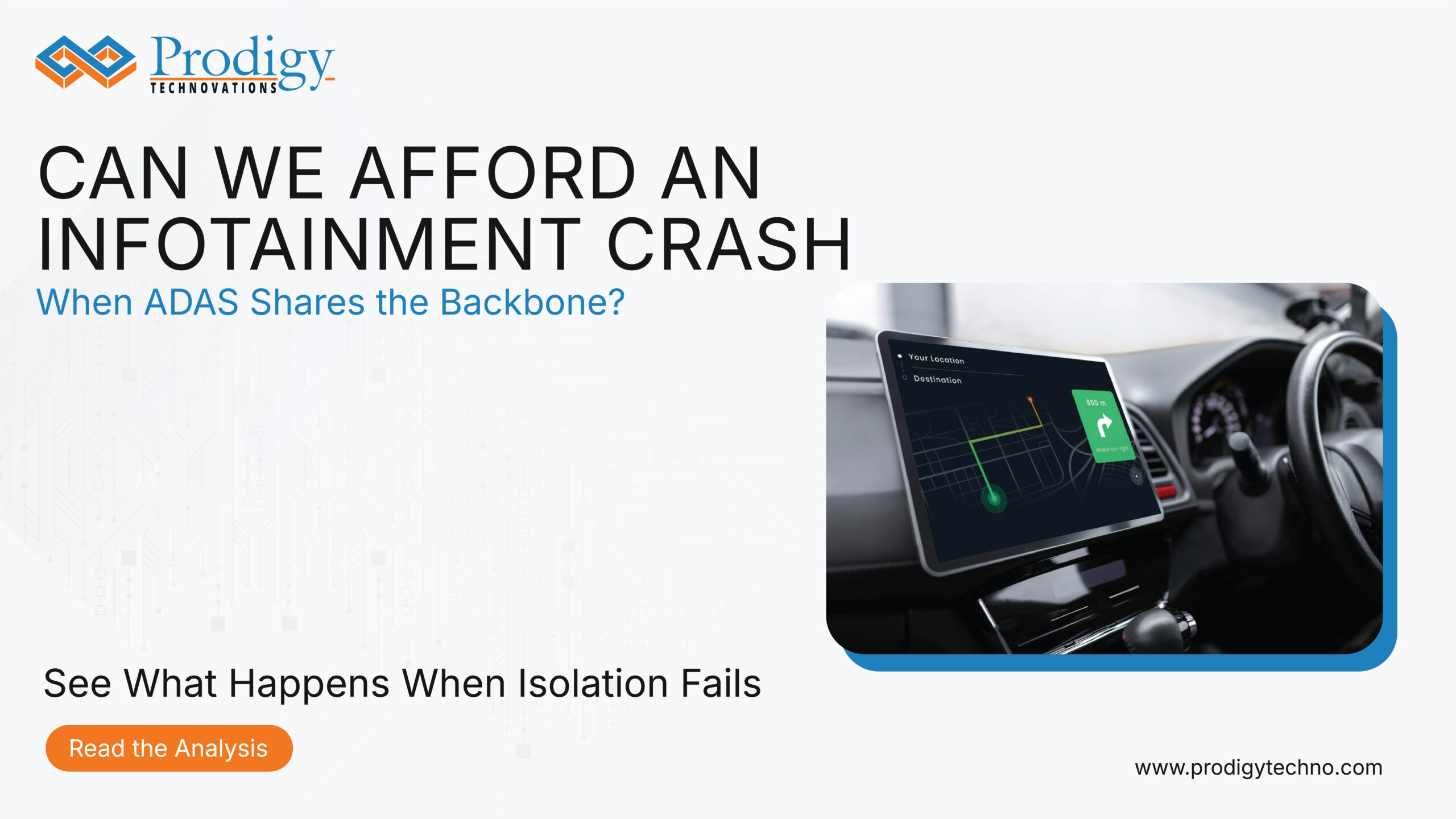
Can We Afford an Infotainment Crash When ADAS Shares the Backbone?” alongside a car dashboard infotainment screen displaying navigation

The amount of pressure to reduce the weight of wiring is extreme in the migration to Zonal Architectures and Software-Defined Vehicles (SDV). It has caused a significant architectural change that has concentrated high-speed Automotive Ethernet backbones as a form of consolidation in order to support both non-critical and infotainment data and safety-critical ADAS traffic.

This is on paper, an efficiency victory. It is a high stakes trade off in the lab that puts Quality of Service (QoS) and system isolation to the test.

Convenience vs Determinism

The key issue facing architects of the modern automotive is ensuring that the failure in one non-critical system starts to bleed into a safety-critical one.

  • The Intent – Use one and high-speed 100BASE-T1 bus and manage both certainly the streams of Spotify and the alarm in the emergency braking car.
  • Risk – When the PTP (Precision Time Protocol) synchronization fails or in case of a burst of infotainment traffic leading to overflow of a buffer, the determinism of the safety-critical system is lost.

The Reality of Engineering – The Isolation Is Not Easy

Hardware failure is not the most dangerous type of crash, it is Priority Inversion.

  • We have seen the situation when a basic door controller on a CAN-FD bus has begun generating Error Frames because the checksum in its response matched a mismatch. This may take up the processing bandwidth of the Gateway ECU causing the delay of important safety packets.
  • A crashing information entertainment system is an inconvenience. The infotainment system with a delay in the backup camera screen feed is a regulatory breach according to the ISO 26262.

Visibility is the Antidote

In Prodigy Technovations, we think that you are not supposed to make any guess on whether or not your safety-related traffic is secure. These architectural boundaries are tested by our Automotive Suite. 

  • Zero latency passive Tapping – The PGY-100BASE-T1-PA is based on passive tap solution. This guarantee the ground truth of the bus timing without necessarily introducing to the network by the analyzer an extra microsecond of latency.
  • Multi-Bus Simultaneous Correlation – CAN-FD, LIN and Ethernet can all be checked using the PGY-LA-EMBD at the same time. This will enable you to observe what point on a slow bus causes a glitch on the high speed backbone resulting in a timeout.
  • High-Resolution Timing High 1GS/s timing – We assist you in capturing the noise spikes of 5ns that are absolutely impossible to record using a standard software.

Good engineering is concerned with fewer mistakes. Do not turn a compacted architecture into a point of destruction.

Tags: 100Base-T1 Automotive Ethernet Protocol Analyzer
  • Next Why is SLC Cache Flushing a High-Stakes Engineering Trade-Off?

Leave a Reply Cancel reply

You must be logged in to post a comment.

Recent Posts

  • Is it possible to survive a safety-critical bus infotainment collision?
  • Why is SLC Cache Flushing a High-Stakes Engineering Trade-Off?
  • xSPI vs OSPI
  • Debugging eMMC Boot Failures: Capturing & Analyzing Boot Data with PGY-SSM
  • Understanding xSPI: The Future of High-Speed Flash Memory Interfaces

Recent Comments

No comments to show.

Archives

  • February 2026
  • August 2025
  • July 2025
  • May 2025
  • April 2025
  • March 2025
  • October 2024
  • August 2024
  • July 2024
  • February 2024
  • December 2023
  • June 2023
  • May 2023
  • January 2021
  • November 2020
  • April 2020
  • September 2019

Categories

  • All products
  • Automotive
  • Datasheet
  • Device
  • Differences
  • eMMC
  • eMMC Protocol Analyzer
  • I2C
  • I3C
  • Logic Analyzer
  • Memory
  • news
  • PCIe
  • Protocols
  • SD
  • SDIO
  • SPI
  • UFS
  • Uncategorized
  • XSPI Protocol Analyzer
  • XSPI Protocol Analyzer

Search

Categories

  • All products
  • Automotive
  • Datasheet
  • Device
  • Differences
  • eMMC
  • eMMC Protocol Analyzer
  • I2C
  • I3C
  • Logic Analyzer
  • Memory
  • news
  • PCIe
  • Protocols
  • SD
  • SDIO
  • SPI
  • UFS
  • Uncategorized
  • XSPI Protocol Analyzer
  • XSPI Protocol Analyzer

Tags

100Base-T1 Automotive Ethernet Protocol Analyzer Clock Stretching DDR5 eMMC Protocol Analyzer I2C I3C I3C Protocol Logic Analyzer Passed PCIe SD SDIO Serial RapidIO Protocol Analyzer UFS UFS 4.0 Webinar XSPI Protocol Analyzer

Our team represents a talented, experienced, and highly specialized group of development engineers, sales and marketing specialists. Through many years of direct engineering involvement with our customers, our personnel have developed expertise in wide range of technologies in serial data.

Follow us on

Linkedin Twitter Facebook Youtube

Quick links

  • Products
  • Resources
  • Company
  • Career
  • Support

Contact info

Prodigy Technovations Pvt Ltd

#294, 3rd Floor, 7th Cross, 7th Main, BTM II Stage,Bangalore – 560 076 | India

+91 80 4212 6100

contact@prodigytechno.com

© 2023 Prodigy Technovations. All Rights Reserved

Request Quote
Request Demo

https://www.youtube.com/watch?v=d9MHo4Ps78g

UFS 4.0


PGY-UFS4.0-PA, UFS Protocol Analyzer is the industry-first working and tested UFS4.0 Protocol Analyzer. It offers protocol data capture and debugging of data across MPHY, UniPro, and UFS protocol layers…


X
  • English