

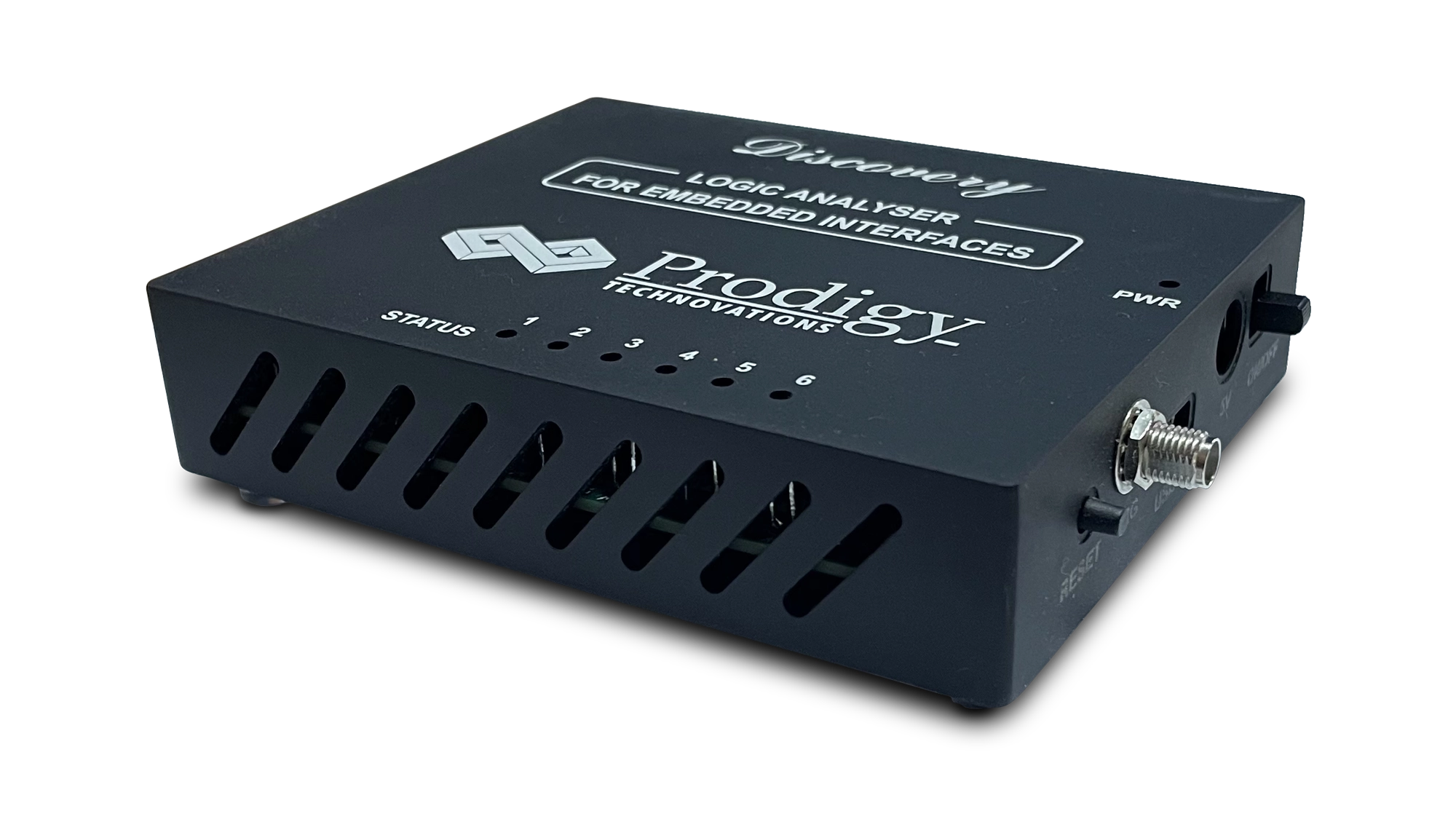
The Discovery logic analyzer series, PGY-LA-EMBD has the built-in capability to debug I2C protocol, SPI protocol, UART, and many other serial protocols. This is a PC-based logic analyzer designed for professional engineers. The Discovery logic analyzer is used to debug embedded systems, the logic analyzer not only reduces the workbench area but also allows it to have a very small form factor and can be used to debug failures in the field. The protocol decode capabilities are designed to debug the logic and protocol issues faced by embedded design teams in the consumer, industrial, home automation, health, and education sectors.
PGY-LA-EMBD is an industry-first logic analyzer in its category which enables engineers to debug timing problems and perform simultaneous protocol analysis of I2C, SPI, UART or I3C, SPMI, and RFFE and also has support for CAN, CAN FD in embedded designs. This enables designers to debug circuit-level and system-level problems quickly.
PGY-LA-EMBD offers 1GS/Sec asynchronous (timing) data and 100Mhz synchronous (state) data capture which makes it an ideal debug tool to address digital design problems. Designers can now easily analyze setup and hold time issues, glitches, and synchronous data activities apart from analyzing protocol issues.
Current generation embedded designers need to collect data from multiple interfaces such as I2C, SPI, UART, I3C, SPMI, RFFE, CAN, and, CAN FD and process it to achieve optimal performance of their design. Embedded design teams need to take timely action to meet the intended objectives of the product. PGY-LA-EMBD decodes I2C, SPI, UART or I3C, SPMI, RFFE, and CAN, CAN FD bus and displays the protocol activity with time stamp information. PGY-LA-EMBD is an ideal instrument to debug hardware and embedded software integration issues and optimize software performance.
Multiple markers enable smart delta measurements which are key to designers. Zoom enables users to look at specific areas of the signal.
Core Queries
Frequently Asked Questions
Core Queries
Frequently Asked Questions
You can purchase Prodigy Technovations solutions by submitting a Request a Quote on our website or by emailing us at contact@prodigytechno.com. Based on your requirements – such as protocol, data rates, and validation stage – our team will recommend the appropriate analyzer, exerciser, or electrical validation solution along with the required configuration.
Prodigy supports a broad range of serial bus and high-speed interfaces used in semiconductor and embedded systems. These include PCIe, UFS, I3C, eMMC, SD, SPI, QSPI, UART, and other serial interfaces. In addition, our tools support application and management layer protocols such as MCTP, SPDM, NVMe-MI, and PLDM over I3C, enabling full-stack validation.
Yes. Prodigy offers evaluation programs where engineers can test the tools in real validation environments. This includes use cases such as protocol decoding, traffic generation, error injection, and conformance testing. Evaluations are guided by our technical team to ensure your specific validation challenges are addressed.
Yes. Prodigy tools provide Python-based APIs and automation capabilities that enable repeatable validation workflows. Engineers can implement regression testing, automated traffic generation, protocol conformance checks, and long-duration stress testing as part of their validation pipelines.
Yes. Prodigy offers oscilloscope-based protocol decode and electrical validation software, allowing correlation between physical layer signal behavior and protocol-level events. This is critical for debugging signal integrity issues, timing violations, and link stability in high-speed interfaces.
Prodigy solutions support the complete validation lifecycle including IP design validation, protocol emulation, silicon validation, conformance testing, and system-level debug. These tools are widely used for interoperability testing, error injection, and corner-case validation across semiconductor, storage, automotive, and data center applications.
Download Logic Analyzer for Embedded Interfaces Presentation
"*" indicates required fields