In the short decade that I3C has existed, it has overhauled microchip communications.
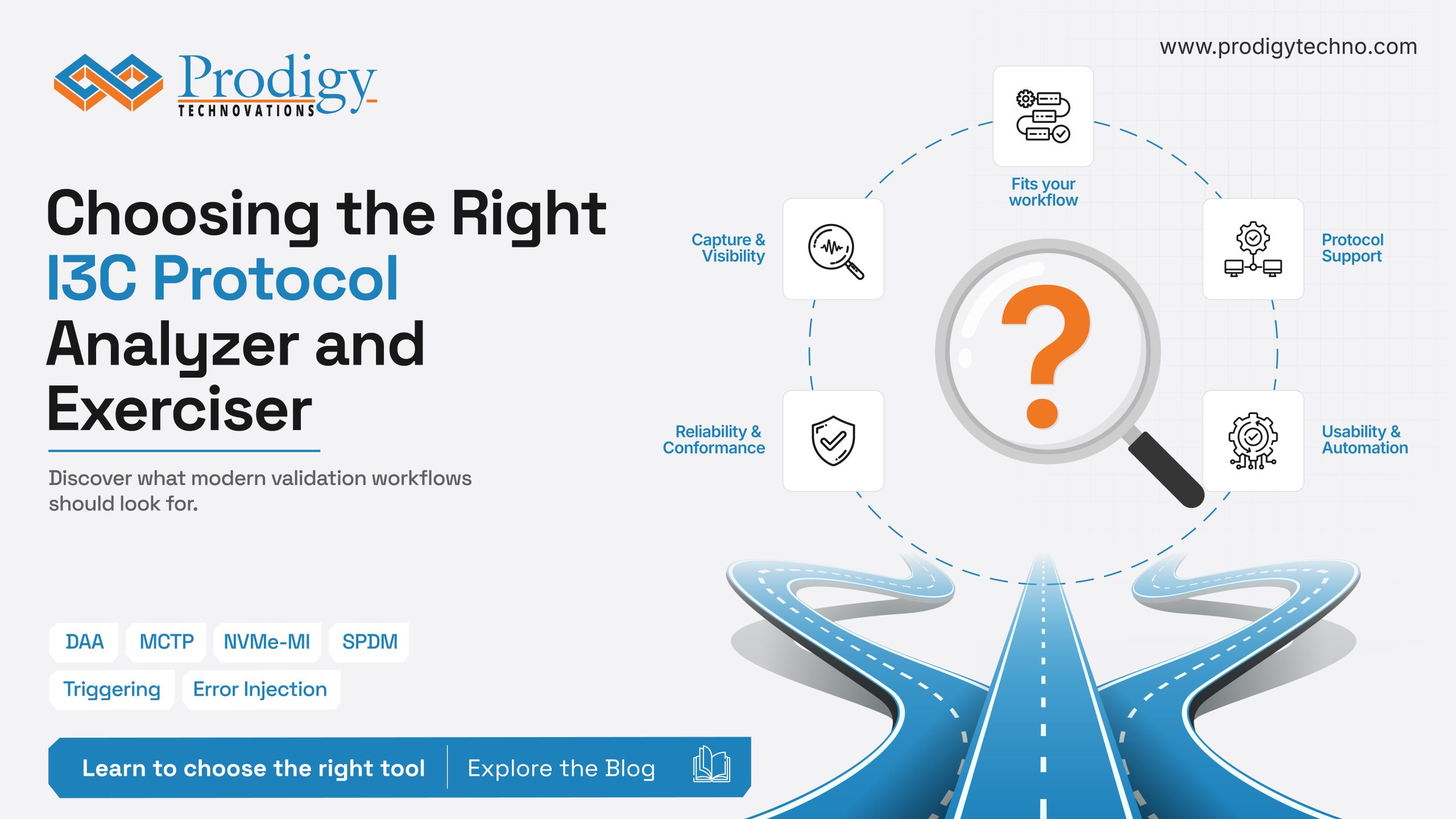
And with increased adoption of I3C around the world, debugging and validation have become more and more important for engineers. Although many I3C protocol analyzers and exercisers are available in the market, making the right choice can be confusing.
If you are struggling with picking an I3C protocol analyzer and exerciser yourself, look no further. Here, we have compiled a list of things you should look for, features you should consider, and questions you should ask to find the right fit for your use case.
A quick overview of I3C, analyzers, and exercisers
Let’s quickly discuss the meaning of these three major terms:
- I3C is Improved Inter-Integrated Circuit. It is a serial communication bus released in 2017 by MIPI, as a successor to the I2C. In function, an I3C bus provides higher data rates, communication speeds, and improved architecture.
- In this context, analyzers are used by engineers to monitor the traffic on an I3C bus, and capture data.
- Similarly, exercisers are also used for bus debugging, but they play a more active role. An exerciser can create signals and protocol transactions for the bus, helping diagnose errors.
With this clarity, we will now discuss exactly what to look for in an I3C analyzer and exerciser.
I3C protocol analyzers and exercisers: features to consider
-
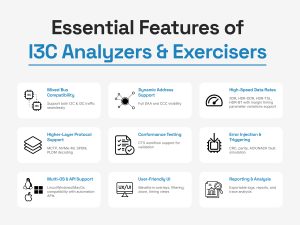
Mixed bus compatibility
In 2026, the embedded platforms you’ll come across won’t be entirely I3C-based. You’ll likely run into mixed communication and architecture.
With this reality check comes a need for a flexible analyzer and exerciser system, that can work with mixed I2C/I3C buses and multiple device configurations. It should also offer interoperability testing, and actually distinguish between I2C and I3C traffic while supporting both.
Without these features, your selected tool will struggle to adapt to real-world scenarios.
-
Dynamic address support
A key aspect in which older protocols and I3C differ is address assignment. I3C controllers can dynamically assign and receive addresses for all the devices. In practice, this can improve the efficiency of the communication as a whole, but create challenges for engineers during debugging.
The best way to tackle this is to pick I3C exercisers that can support such dynamic address features. The right tool will support DAA, or Dynamic Address Assignment, as well as CCC, or Common Command Code. With these support features, engineers will be able to trace communication between different components accurately.
-
Data rate support
One of the important I3C analyzer features is data rate support. As discussed earlier, real-life systems will often involve mixed buses with mixed data rate modes.
The ideal I3C protocol analyzer should be able to support all the transmission speeds by providing full support for all transmission modes, including SDR , HDR-DDR, HDR-TSL, HSDR-TSP, and HDR-BT.
-
Protocol support over I3C
There is a long list of functions that I3C buses enable. For example, I3C can also support higher-layer protocols such as MCTP, NVMe-MI, SPDM, and PLDM.
If the I3Cs in your ecosystem are actively engaged in this kind of protocol support, you’ll need analyzers and exercisers that can provide visibility into these protocols. Here, the ideal debugging tool will help support these transport and application-layer protocols.
-
Conformance
CTS or Conformance Test Suites are used in 2026 to verify that devices actually comply with official protocol standards. Having access to the right test suites can cut down a lot of the debugging and validation time. Although there is no specific list, an ideal analyzer and exerciser should support CTS workflows for I3C, MCTP, NVMe-MI, and SPDM.
-
Error injections and triggering
In 2026, you’ll also need the right testing environment, and the right tool to create it. An ideal I3C exerciser feature is error injection capability.
With error injections, you can create test environments for CRC errors, Parity errors, and ACK/NACK errors, to ensure that the I3C protocol is working as expected. This feature addition will make your validation process much stronger.
You should also consider advanced triggering support. With features like protocol-aware triggers or multi-state triggers, engineers can reliably isolate and diagnose specific events.
-
Multi-OS and API support
This feature can be easy to overlook if you’re wrapped up in the technical details, but it is just as important. Engineers need analyzer and exerciser tools that offer software and technical support.
Whether you’re working on Windows or Linux, the right tool should be compatible with your OS of choice. In addition, it should offer script and API support, which can help engineers automate testing, create validation workflows, generate custom traffic, among other tasks.
-
User-friendly UI
When looking for the best I3C protocol analyzers and exercises, don’t forget usability! It’s one thing to have a long list of technical features in your toolkit, and another for the features to be actually usable.
Look for these keywords to ascertain if the tool in question will offer good UI:
- multi-domain views
- timing plots and views
- protocol listing windows
- waveform overlay
- advanced search and filtering tools
- cursor and zoom features
-
Reporting and analysis
Finally, analyzer and exerciser tools are only as helpful as their reporting capabilities. With accurate logs, error reports, and desired export formats like HTML or CSV, engineers can keep track of every step of the debugging process, and make sure that nothing is missed.
Making the most of your I3C analyzer and exerciser
The complexity of embedded systems will only increase with time. Investing in the right I3C protocol analyzer and exerciser tool is important, because it will set the stage for your efficiency, going into 2026 and beyond.
Remember that the best I3C protocol analyzer and exerciser will fit your use case. Explore the available options and pick one that solves your pain points.
Consider looking for something like an integrated analyzer and exerciser. For example, Prodigy Technovations’ PGY-I3C-EX-PD is designed specifically for solving the problems modern engineers will face.
As an integrated solution, it combines analysis and exercising capabilities, letting you capture, decode, and generate traffic on a single platform. It can support both I3C and legacy I2C analysis. It offers error injections, triggering and filtering, along with protocol support for MCTP, NVMe-MI, SPDM, and PLDM. It can capture DAA sequences and IBI events. These features combine to provide full visibility into the inner workings of your devices – all in an easy-to-use user interface.
If you’re looking for an analysis and exercising solution in 2026, PGY-I3C-EX-PD can fit the bill just right. Check out how it fits your workflow.