
Modern infrastructure is getting harder to manage. AI servers pack hundreds of monitored components into a single rack. DDR5 memory modules now regulate their own power and report their own temperature. CXL systems connect memory and compute across devices that weren’t connected at boot. Managing all of it requires an interface that can scale with that complexity. Something that I3C, a two-wire serial protocol, has proven capable of delivering at infrastructure scale. Through this article, we unpack why I3C ended up in all three, and what it means for engineers building and validating these systems.
What I3C is and Why it Matters Now
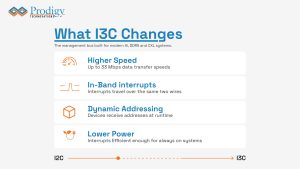
Key benefits of I3C for modern AI, DDR5, and CXL systems.
I3C is MIPI Alliance’s successor to I2C. It comes with the same two-wire bus, but is significantly faster, takes less power, and is much smarter about device management.
AI servers, DDR5, and CXL have each independently arrived at a point where they need exactly what I3C offers. And that is a fast, efficient, intelligent management bus that doesn’t require dedicated interrupt pins or significant power overhead.
What I3C actually changed
- HDR mode: The protocol introduces HDR, or High Data Rate modes, reaching up to 25 Mbps in HDR-DDR and 33 Mbps in HDR-TSP/TSL. Well beyond what standard I2C can deliver.
- In-band interrupts: Devices signal the host over the same two wires rather than through separate GPIO pins. This alone reduces pin count considerably on dense boards.
- Dynamic addressing: The host assigns addresses to devices at runtime rather than relying on a fixed hardware configuration.
- Low power overhead: Power draw stays low enough to keep the bus active on always-on sensor rails without it becoming a thermal or energy concern.
I3C in AI Servers
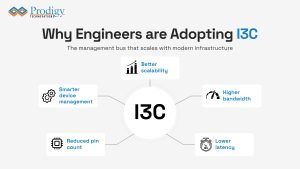
AI servers are dense. A single rack can have hundreds of components that generate heat, consume power, and require continuous monitoring. Temperature sensors, voltage regulators, power monitors, and fan controllers all need a path back to the host. The problem is that AI accelerator density has grown faster than I2C can handle. The number of devices on the management bus has increased a lot, which makes I2C’s address space and speed real constraints.
How I3C in servers solves this
- Dynamic addressing lets devices be enumerated and assigned addresses at runtime. That simplifies large shared-bus topologies and avoids many of the static-address conflicts common in I2C systems.
- In-band interrupts mean each device can signal the host without a dedicated GPIO, which at this scale is a meaningful reduction in routing complexity.
- I3C reaches 12.5 MHz in SDR mode and higher in certain HDR configurations, meaning telemetry data moves fast enough to be actionable.
The result is a management bus that can scale with the hardware around it, which is what AI server designers needed.
DDR5 and the Case for a Smarter Memory Module
DDR5 changed how the memory module itself is managed. One of the significant changes is the move to an on-module power management architecture. Each DIMM, or Dual Inline Memory Module, now carries:
- Its own power management IC, or PMIC
- A new component called the SPD5 hub
How memory management used to work
In DDR4 and earlier generations, EEPROM sitting on an I2C bus handled the Serial Presence Detect (SPD) function. It stored timing parameters and module information, and that was largely the extent of its role. The host read it once at boot and moved on.
How DDR5 changes that
The SPD5 hub is an active component that requires a faster, more intelligent bus than I2C could provide, which is why DDR5 mandates I3C. Through it, the host can:
- Adjust voltages in real time
- Monitor temperature continuously
- Respond to thermal events as they happen
How I3C in DDR5 works
- In-band interrupts: The DIMM can alert the host to a thermal event without a separate signal line.
- Sufficient speed: Real-time telemetry moves fast enough to take meaningful actions.
- Dynamic addressing: Multiple DIMMs share the same I3C bus, so as to keep the topology manageable as the slot count increases.
I3C as CXL Sideband
CXL, or Compute Express Link, is built around the idea that memory does not have to live inside the server that uses it. Compute and memory can be separated, pooled, and shared across a fabric. A host processor can access the memory of a different device, or even a different chassis, as if it were local. This changes how data centers think about memory capacity and utilization.
The management problem CXL creates
The memory management is relatively contained in a traditional server. The host knows what is attached, where it is, and how it behaves.
In a CXL topology, that changes:
- Memory devices can be added, removed, or reassigned dynamically
- The host needs to track devices it did not know about at boot
- The management interface needs to handle that variability without adding significant overhead or requiring dedicated infrastructure per device
Where I3C fits in
- New memory devices can be brought onto the management bus without pre-assigned addresses or manual configuration.
- Devices can surface errors, thermal events, or status changes back to the host over the same two wires. In-band interrupts make that possible without additional signal lines.
- I3C was designed to handle large numbers of devices on a shared bus, which maps directly to the topology complexity of pooled memory environments.
CXL is still maturing as a standard, but the management layer underneath it is already taking shape. I3C is slowly becoming the preferred choice for that sideband role, for the same reasons it showed up in AI servers and DDR5. It scales, it stays lean, and it does not require dedicated hardware for every device it manages.
Where Engineers Run into Problems with I3C
I3C’s strengths as a protocol are also what make it harder to validate. A bus that handles dynamic address assignment, in-band interrupts, HDR mode transitions, and multi-device topologies simultaneously has more moving parts than I2C.
Each of those features introduces scenarios where something can go wrong in a way that is not immediately visible, such as:
Dynamic Address Assignment (DAA) failures
During the DAA process, the host walks through a sequence of steps to enumerate and assign addresses to every device on the bus. If a device does not respond correctly, or if the sequence is interrupted, the bus can end up in a state that is difficult to diagnose.
HDR mode transition errors
Transitioning in and out of HDR mode follows a defined sequence between the host and devices on the bus. If that sequence does not complete cleanly, the bus can stall or fall back to a mode neither side was expecting. Catching this requires visibility into the control sequences happening at the protocol level.
In-band interrupt ambiguity
Multiple devices share the same in-band interrupt mechanism on the bus. That makes interrupt analysis difficult. To identify which device raised the interrupt, what triggered it, and how the host responded, engineers need a correlated view of the entire transaction sequence.
Closing the Visibility Gap
None of these failure modes above is visible at the signal level alone. Moreover, I3C has more protocol states than I2C, and the systems it now lives in have added further complexity. You need protocol-level visibility to find failures. And that requires tooling built specifically for I3C.
PGY-I3C-EX-PD from Prodigy Technovations is built from the ground up to address this specific issue. The platform operates simultaneously as an analyzer and exerciser. It captures and decodes live I3C traffic while also generating traffic to simulate a controller, secondary controller, or up to three targets. This means engineers can validate DUT behavior without needing a separate traffic source, and debug real bus activity without switching tools.
It also includes protocol-aware triggering, using which engineers can capture DAA sequences, HDR transitions, and IBI events with precision.
The platform provides full decode support for I3C, MCTP, NVMe-MI, SPDM, and PLDM. That makes it possible to trace cross-layer failures in a single correlated view. Error injection lets teams validate how their system responds to failure conditions before those conditions appear in the field. And continuous streaming to host storage extends capture windows from seconds to hours, making intermittent failures catchable.
For teams working across AI server, DDR5, and CXL platforms where I3C validation is imperative, PGY-I3C-EX-PD can easily close the visibility gap. See how it fits your workflow.